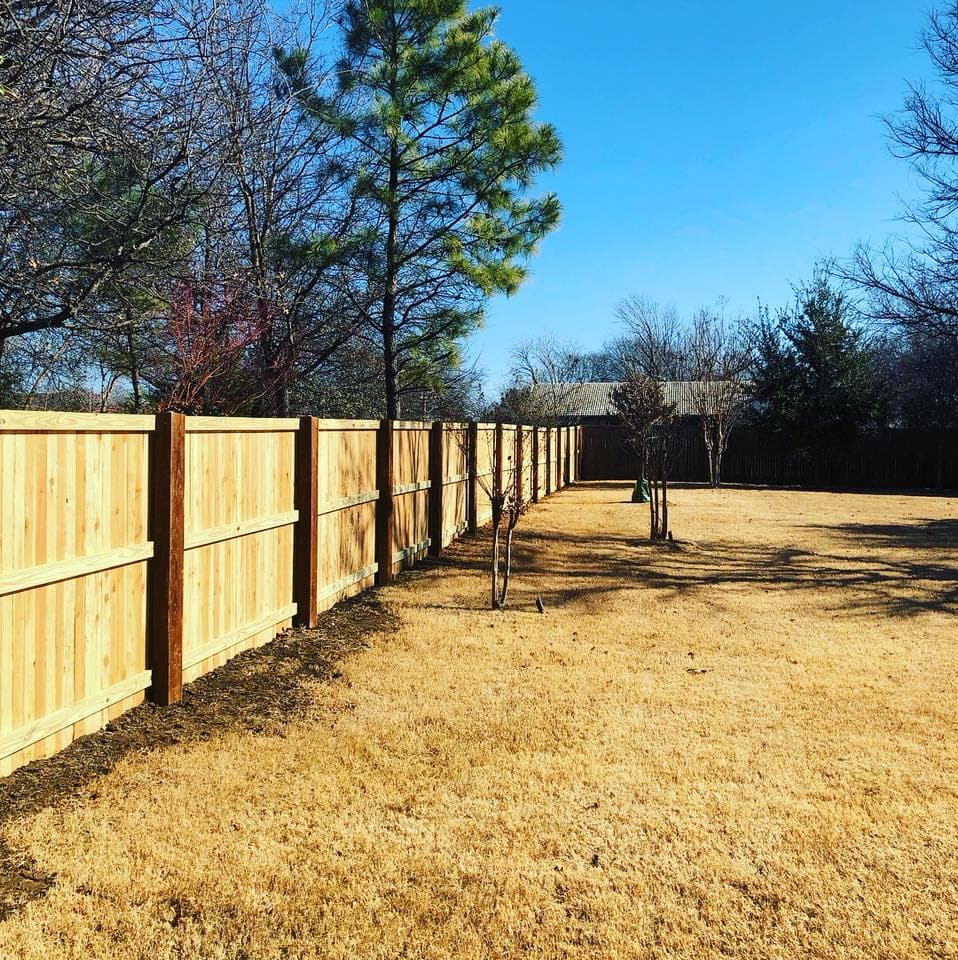
A fence in North Texas has to cope with clay soil that moves through the year, wind that gets behind every panel, and sun that greys untreated timber within a season. Most of the fences we replace did not fail at the panels. They failed at the posts.
Posts set properly
Correct depth and concrete footings. In moving clay soil this is what decides whether the fence lasts.
Built for the wind
Panel and rail construction specified for the exposure, not a standard kit.
HOA and survey aware
Height, style and boundary line checked before we build, not after a complaint.
Materials
Cedar. The standard choice for residential fencing in this region, and the one we fit most. Naturally rot- and insect-resistant, dimensionally stable, and it looks good whether sealed or left to weather.
Treated pine. Lower cost, widely used, and serviceable. More prone to warping and cupping through Texas humidity swings than cedar.
Ornamental metal. Wrought-iron style panels for front boundaries and pool enclosures, where you want a defined boundary without losing the view. Very long service life.
Chain link. Practical and economical for larger perimeters, dog runs and utility areas.
Vinyl. No maintenance and no rot, at a higher upfront cost. Worth considering if repainting and sealing is not something you want to take on.
Why posts decide everything
Almost every failed fence we take down failed at the posts, and there are two reasons for that in North Texas specifically.
The first is soil. Our expansive clay swells when wet and shrinks when dry, and it does that repeatedly through the year. A post that is not set deep enough gets levered by that movement until it loosens, leans and eventually snaps at ground level.
The second is water. The point where a timber post meets the soil stays damp longest and is where rot starts. Correct concrete footings that shed water away from the post, rather than forming a cup that holds it around the base, make a very large difference.
So we set posts to proper depth, in concrete, and let them cure before hanging anything. It is slower. It is also the difference between a fence that lasts fifteen years and one you are propping up in five.
Gates get built, not just hung
Gates are the part that fails first, because they are the only moving component and they take all the handling. A gate on undersized posts sags within a year and then drags on the ground.
We set gate posts heavier than line posts, brace the frame diagonally, and use hardware sized for the weight and span. If you want a double gate for vehicle access, we will talk through span and drop-rod arrangements before building it.
Fencing alongside other exterior work
If you are already having siding or exterior painting done, fencing fits naturally into the same project — one contractor, one schedule, and the timber colour chosen to work with the house.
Also worth reading: your guide to residential fencing options.
How a fencing job runs
Site survey
Boundary line, levels, drainage, access and any HOA restrictions confirmed.
Specification
Material, height, style and gate positions agreed, with documentation for HOA approval if needed.
Removal and disposal
Old fence out, including the old post footings — leaving those causes problems later.
Post setting
Posts set to depth in concrete and allowed to cure before anything is hung on them.
Rails, panels and gates
Framework built, panels fitted, gates hung square with proper hardware.